
Conversation Types
Most conversation types are built around a specific person, so you select a Client Digital Twin when you create one. Difficult Conversations and Career Conversations can be created without one, since they often involve someone inside your own organisation.Creating a conversation
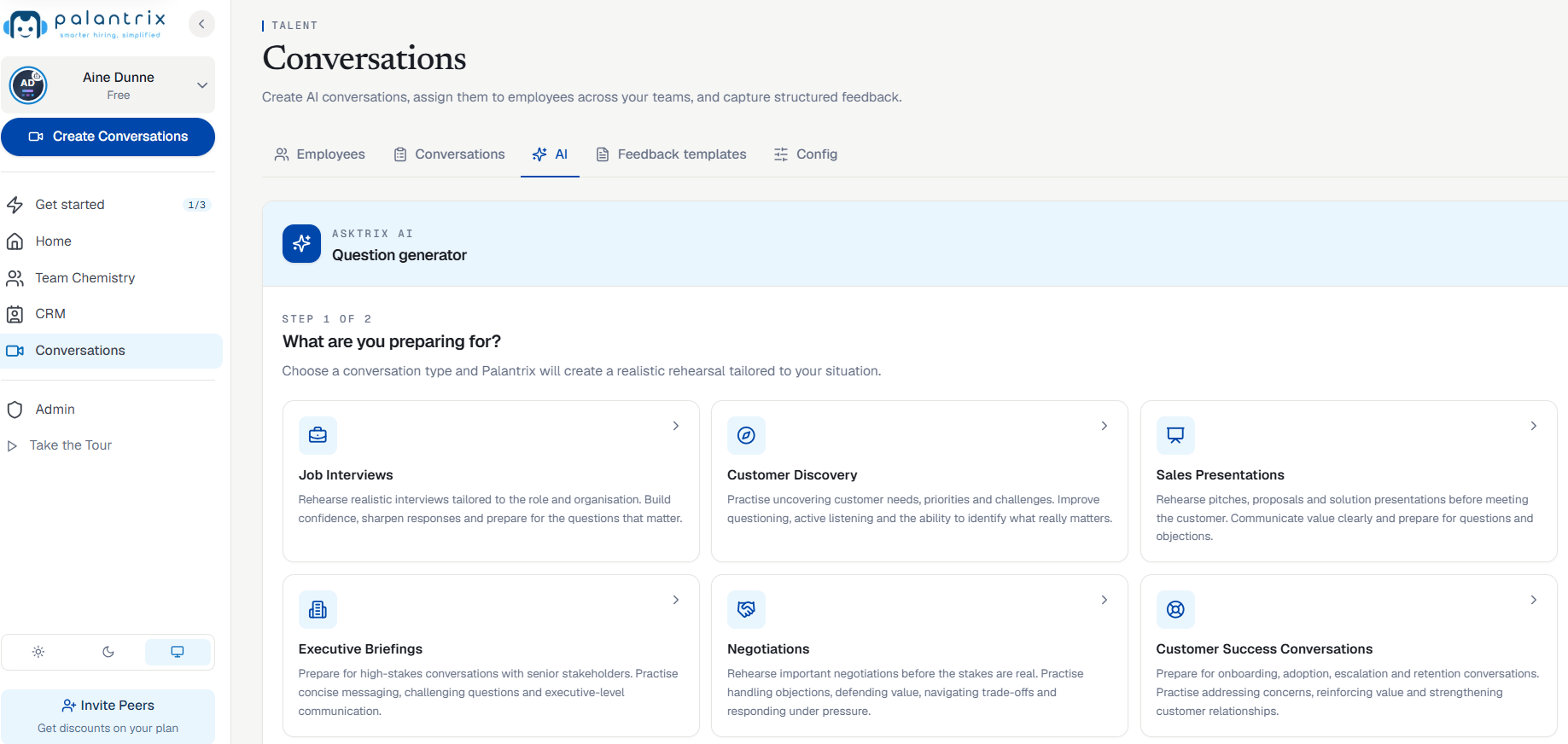
Open the AI tab and choose Question generator. Pick your conversation type, then the Client Digital Twin your team will be meeting where one applies. Choose a feedback template, which sets what the attempt is measured on, and assign it to one person or several. Questions come from what you know about that contact, not a generic script. A finance director will push on cost and want figures substantiated. A technical evaluator will ask how it’s implemented and what happens when it fails. Your team rehearses the conversation they’re actually going to have.Practicing
Assigned conversations appear on each person’s home page. They can run through one as many times as they want, and every attempt is private to them until they choose to share one. That matters. If people think their first attempt goes to their manager, they’ll treat it as a test rather than as practice, and you lose the repetition the whole thing depends on.Feedback & Scoring
After each attempt, Palantrix gives feedback against the template you chose. Scores are read against your Team Chemistry baseline, so results mean something relative to your own team rather than an industry average. Feedback is written for the person who took part. It’s there to make the next attempt better, not to rank anyone.After the real conversation
Once the meeting has happened, Palantrix follows up in Slack or Microsoft Teams to ask what was asked and which objections came up. That feeds back into the Client Digital Twin, so the next person preparing for that customer starts from a better picture.Quick Tips
- Start with a test Job Interview to try and understand your customer better and build up a Customer Readiness Index score (CRI) so that you can review and identify customers that need more attention before the real conversations take place.
Feedback is specific to the person practicing and the customer they’re meeting, so it gives them something concrete to act on before the real conversation takes place.